
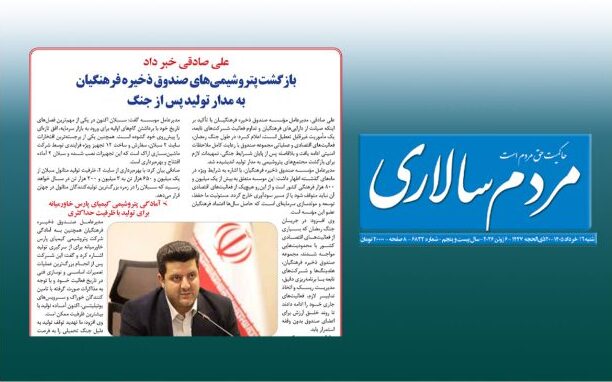
According to a report by Mardomsalari Newspaper, Ali Sadeghi, the CEO of the Teachers Investment Fund, emphasized that safeguarding the assets of educators and ensuring the continuity of subsidiary operations is an “uninterruptible mission.” He announced: “Throughout the Ramadan War, the economic and operational activities of the Teachers Investment Fund were maintained with full adherence to security protocols. Immediately following the conclusion of the wartime conditions, necessary measures were implemented to return the petrochemical complexes to the production cycle.”
The CEO of the Teachers Investment Fund, referring to the exceptional circumstances of recent months, stated: “This institution belongs to over 1.8 million educators across the country; therefore, none of its economic activities should be halted or diverted from the path of profitability. Our responsibility is the preservation, development, and monetization of the capital that results from years of trust by the member educators.”
He added: “During the Ramadan War, while many economic activities in the country faced constraints, the Teachers Investment Fund, its holdings, and subsidiary companies continued their routine activities through meticulous planning, risk management, and the adoption of necessary measures to ensure the uninterrupted continuation of value creation for the members.”
Sadeghi clarified: “Immediately after the cessation of wartime conditions, actions to achieve maximum return of production units to the operational cycle were prioritized, driven by the high resolve of managers and workers. Companies active in the petrochemical sector, which play a crucial role in the group’s profitability, were placed at the forefront.”
Sabalan Petrochemical Rapidly Returns to Production
Referring to the swift resumption of production at Sabalan Petrochemical, the CEO stated: “This complex is one of the most vital productive assets of our members. Through diligent and continuous follow-ups with competent authorities—specifically regarding the prioritization of utility allocations and necessary technical actions—and through the efforts of our dedicated specialists and staff, it has returned to the production cycle.”
He further noted: “Sabalan’s return to production is a symbol of the capability of Iranian industrialists and a manifestation of the spirit of self-reliance and ‘Jihadi management’ under difficult conditions. All stages of returning to the production cycle were achieved through numerous meetings, negotiations, and effective follow-ups. Today, this complex is ready for full-capacity production. Every month of earlier production significantly impacts the profitability and value creation of the Teachers Investment Fund.”
Highlighting that the enemy’s attacks failed to deter the resolve of petrochemical industry workers, Sadeghi stated: “These attacks, which targeted parts of the petrochemical industry, not only failed to create a rift in our determination but further strengthened the Iranian resolve for resilience.”
He stated: “With a current production capacity of 1.65 million tons of AA-grade methanol per year, Sabalan Petrochemical is considered one of the strategic producers of this product in the country. The company has clear targets for foreign currency earnings, revenue generation, wealth creation, and sustainable production development.”
The CEO added: “Sabalan is now opening a new horizon in one of the most significant chapters of its history by taking the initial steps for IPO and entering the capital market. Furthermore, one of the most prominent achievements of the Sabalan Site 2 project is the commissioning and fabrication of 12 specialized process equipment units by ‘Machine Sazi Arak’. These units have been installed, and Sabalan 2 is ready for inauguration and commissioning.”
Sadeghi noted that with the operation of Site 2, Sabalan’s methanol production capacity will increase from 1.65 million tons to 3.3 million tons per year, placing Sabalan among the largest methanol producers in the world.
Readiness of Kimia Pars Khavare-Miyaneh Petrochemical for Maximum Production
The CEO of the Teachers Investment Fund also pointed to the readiness of Kimia Pars Khavare-Miyaneh Petrochemical to resume production, stating: “Following the completion of the largest overhaul and technical modernization operation in its history, and following negotiations with feedstock and utility providers, this company is now ready for production at its maximum possible capacity.”
He added: “We transformed the threat of production shutdown caused by the conflict into an opportunity. During this period, we completed essential maintenance activities that required production halts, including a comprehensive overhaul of key equipment such as furnaces, towers, heat exchangers, oxygen filters, the resolution of critical points, cooling tower issues, and the replacement of necessary catalysts.”
Sadeghi emphasized: “Eliminating operational bottlenecks, modernizing strategic equipment, and upgrading technical standards have ensured that this complex enters the production cycle with greater operational stability and enhanced productivity.”
Wealth Creation for Educators: The Teachers Investment Fund’s Top Priority
The CEO of the Teachers Investment Fund stated that all actions taken must ultimately lead to increasing the benefits for the members, saying: “We consider ourselves the trustees of the educators’ capital and believe that every single day is an opportunity for profitability and wealth creation.”
He continued: “Accordingly, in recent years, the primary approach of the Teachers Investment Fund has been the activation of stagnant assets, completion of semi-finished projects, increasing the productivity of companies, and returning economic units to the cycle of profitability.”
Referring to the achievements of the past two years, Sadeghi concluded: “Breaking records in profitability, distributing the highest dividends in the history of the Teachers Investment Fund, timely payment of retirees’ share capital, organizational restructuring of companies, listing subsidiaries on the capital market, and completing major economic projects are all results of adopting this strategic approach.”