
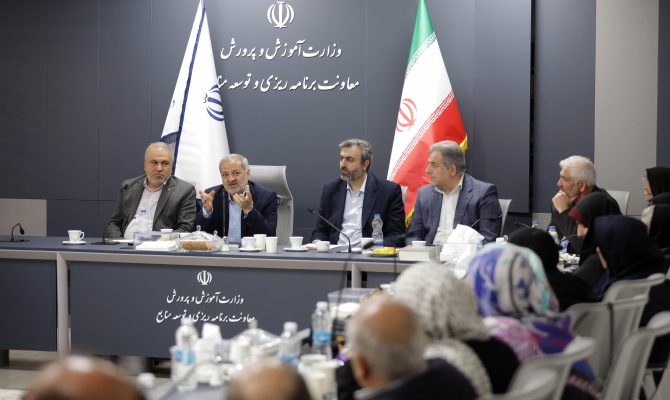
Minister of Education Announces Pursuit of Statutory Reform, Restructuring of Loss-Making Companies, Strengthened Financial Oversight, and Drafting of Election Regulations for Teacher Representatives in the Cultural Teachers Investment Fund
The Minister of Education, during a meeting with a group of members and stakeholders of the Cultural Teachers Investment Fund, announced the pursuit of statutory reform of the Fund, the restructuring of loss-making companies, the strengthening of financial oversight, and the drafting of election regulations for teacher representatives in the Fund. He also emphasized the necessity of determining the share of retired teachers and moving toward stock-market investment instead of traditional holding structures.
According to the Information Center and Public Relations Department of the Ministry of Education, Ali Reza Kazemi, the Minister of Education, stressing the need to protect members’ interests, reform the Fund’s structure, and pursue teachers’ demands, stated: “Reforming the statute, determining the status of loss-making companies, and creating the conditions for teacher representatives’ participation in the Fund’s governance are among the main axes of the programs currently being pursued.”
Referring to the issue of the Value Ownership Plan (Arzesh-e Malekaneh) for teachers, Kazemi described it as one of the important demands of the Fund’s members and said: “Realizing this demand requires legal clarification of the Fund’s nature and the ownership status of its capital.”
He noted that the statutory reform had been prepared in this regard and submitted to the government for review; however, the proposal was not accepted, and the matter remains in the process of administrative follow-up.
The Minister of Education emphasized that without resolving the legal and structural issues of the Fund, achieving a sustainable solution for the Value Ownership Plan would face difficulties, and stressed that the objective must be pursued in a manner that precisely safeguards the rights of both serving and retired teachers.
Reforming the Fund’s Structure: Moving from Holding to Investment
Kazemi identified the expansion of companies and the complexity of the Fund’s holding structure as one of its fundamental challenges. He stated that the current management’s approach focuses on reducing direct ownership, merging holdings, determining the status of loss-making companies, and shifting toward professional investment in the capital market.
Referring to the necessity of utilizing specialized capacities in asset management, he stated: “Instead of directly managing a large number of companies, it is possible to provide more efficient management of teachers’ assets through specialized investment mechanisms and the acquisition of shares in reputable companies.”
Kazemi also emphasized the need for expert evaluation of investment projects and avoidance of decisions lacking economic justification, stating that the Fund’s resources must be directed toward preserving and increasing members’ interests.
Emphasis on Financial Integrity and Prevention of New Legal Cases
Referring to the numerous legal cases remaining from previous years within the Fund, the Minister of Education identified the resolution of these cases as a management priority and stressed the need to prevent the creation of new cases and decisions that could impose additional legal and financial costs on the Fund.
He also described administrative, financial, and ethical integrity as essential requirements for working in the Cultural Teachers Investment Fund and emphasized the necessity of continuous oversight of the organization’s performance, compliance with regulations, and utilization of supervisory capacities.
Kazemi referred to the establishment of the Protection Unit within the Fund and described monitoring performance and safeguarding resources as part of management’s responsibility toward teachers’ capital.
Election Regulations for Teacher Representatives Prepared
Kazemi announced that the election regulations for six representatives from the teaching community, based on the Fund’s statute, have been prepared and stated that the groundwork for holding these elections is being pursued.
He also referred to strengthening the Board of Trustees and the Board of Directors of the Fund and utilizing legal and economic expertise to examine the Fund’s issues. He emphasized the necessity of appointing managers based on professional and specialized qualifications, free from non-specialized recommendations or considerations.
According to the Minister of Education, forming advisory teams and continuing meetings with activists and teacher representatives can help directly convey members’ demands, examine issues, and strengthen the accountability of the Fund’s management.
Retired Teachers’ Share in the Value Ownership Plan Must Be Precisely Determined
The Minister of Education emphasized that retired teachers have also contributed to the creation and accumulation of the Fund’s assets and stated that the rights and share of this group must not be overlooked in any of the proposed models for structural reform and the realization of the Value Ownership Plan.
He also announced the formation of a working group to examine issues related to retired teachers and stated that topics such as livelihood, healthcare, honoring, and utilizing the professional experience and capacity of retirees are on the working group’s agenda.
Kazemi, while appreciating the concerns of the members present at the meeting, emphasized the necessity of pursuing demands in an atmosphere based on dialogue, presenting expert proposals, and avoiding unverified accusations.